This blog definitely touched my heart. A woman who works in newborn screening has a niece who screened positive for PKU (a metabolic disorder). She writes about her family's experience, their gratitude and how she will never view her job the same way again. Many of her sentiments are familiar to me and our family's experience with newborn screening.
Association of Public Health Laboratories Blog - Newborn Screening Gets Personal

Saturday, June 22, 2013

Tuesday, June 18, 2013
Talking About Teeth
LB had his first visit with the dentist last week. I was more anxious to take him to the dentist than I was with our older son because, let's face it, LB eats and drinks all the time and we don't stop to brush his teeth any more often than we do with his older brother. We like to make sure LB's getting the calories he needs, so during the day he snacks a lot and his drinking cup is usually filled with milk or juice instead of plain water. At night, we brush his teeth before bed, but he can sometimes wake up and eat once or even twice during the night and we don't really want to get him all agitated and keep him awake any longer than necessary by brushing his teeth after each feeding. I was honestly worried about all that sugar sitting on his teeth throughout the day and during the night. I was convinced that the dentist would take one look and scold us for not taking better care of those little teeth.
Before our appointment, I visited the FOD Support website and printed out the MCADD Information for Clinicians because I wanted to be able to hand something to the dentist to explain LB's metabolic disorder so that he would understand the feeding system we've been working with for the last 15 months and the importance of making sure he eats often, even if it's in the middle of the night and even if we can't immediately brush his teeth afterwards. I really like this resource because I've been told that in 8 years of medical education, metabolic disorders are covered in only about a paragraph. If that is true for doctors, I imagine it may be even less for dentists and I wanted him to have a piece of reference material for LB's chart and his own education.
I was very pleased with the dentist's reaction to LB's teeth -- they are fine! He did a regular cleaning and brushed them with a fluoride treatment that he assured us would help keep the enamel strong despite his feeding needs. I was also pleased that he asked a lot of questions about MCADD and LB's medical history and seemed genuinely interested in learning more. He even asked his assistant to leave LB's chart on his desk so that he could read over the clinician information sheet later that day. I'm not sure that MCADD can have any detrimental effects on teeth, other than the concern about keeping them clean despite the need for frequent feedings I guess, but I told him that if he had any questions, he could contact our metabolic team for additional resources. In all, I think it was a great (and very reassuring) visit.
The big news in teeth now is that LB has managed to sprout 3 new ones in the last week! He was standing at 7 for a couple months, but his gums were definitely lumpy at his dental appointment so we were sure more would be popping through soon. Sure enough, he finished out the last of the front bottom teeth and got two molars shortly after his appointment bringing his tooth total to a whopping 10! We are officially half way through teething - hooray! Now that's something to smile about =)
.JPG)
Before our appointment, I visited the FOD Support website and printed out the MCADD Information for Clinicians because I wanted to be able to hand something to the dentist to explain LB's metabolic disorder so that he would understand the feeding system we've been working with for the last 15 months and the importance of making sure he eats often, even if it's in the middle of the night and even if we can't immediately brush his teeth afterwards. I really like this resource because I've been told that in 8 years of medical education, metabolic disorders are covered in only about a paragraph. If that is true for doctors, I imagine it may be even less for dentists and I wanted him to have a piece of reference material for LB's chart and his own education.
I was very pleased with the dentist's reaction to LB's teeth -- they are fine! He did a regular cleaning and brushed them with a fluoride treatment that he assured us would help keep the enamel strong despite his feeding needs. I was also pleased that he asked a lot of questions about MCADD and LB's medical history and seemed genuinely interested in learning more. He even asked his assistant to leave LB's chart on his desk so that he could read over the clinician information sheet later that day. I'm not sure that MCADD can have any detrimental effects on teeth, other than the concern about keeping them clean despite the need for frequent feedings I guess, but I told him that if he had any questions, he could contact our metabolic team for additional resources. In all, I think it was a great (and very reassuring) visit.
The big news in teeth now is that LB has managed to sprout 3 new ones in the last week! He was standing at 7 for a couple months, but his gums were definitely lumpy at his dental appointment so we were sure more would be popping through soon. Sure enough, he finished out the last of the front bottom teeth and got two molars shortly after his appointment bringing his tooth total to a whopping 10! We are officially half way through teething - hooray! Now that's something to smile about =)
.JPG)
Thursday, June 6, 2013
Fifteen Months
.JPG)
It has been a few months since I've done a monthly update, but there's so much going on in LB's life right now, I couldn't help but give a little update.
Other than a couple typical toddler runny-nose incidents that were snotty and messy, but didn't seem to bother him one bit, he has remained 100% healthy. Hooray!
We're starting to get a lot more words. I read a few articles that mentioned children with MCADD can have speech delays and since LB wasn't really talking at all, I was starting to wonder whether I should ask the pediatrician about it. Then, all of a sudden, we went from a vocabulary of "this," "that," "yes," and "daddy" to a whole lot more words -- ball, catch, dog, juice, night-night, mommy (hooray!!), kiss, and probably a few others I'm not remembering right now. In any event, I'm a whole lot less concerned about his speech than I was a month ago.
He is definitely a boy on the move! He has been walking since January, but is very adept at it now. He can walk/run easily on all surfaces and doesn't trip and fall all that often anymore (this makes me happy because one of my least favorite things is when my boys face-plant on the concrete - it just makes me cringe to watch it and not be able to stop it). He is also discovering climbing and can successfully work his way up onto all sorts of high furniture - the kitchen table, the couch, the beds. He has also figured out that if he can't get up onto something, he can always go grab the step stool from the bathroom (the one his older brother uses to reach the sink) and set it beside the item he'd like to climb -- voila!
His favorite toys right now are all things sports. He loves all types of balls -soccer, foot, basket, base, bowling, golf, etc. - along with all the long sticks that accompany them. He can swing a mean golf club with pinpoint accuracy on your shin. He can play catch with us for 15 minutes at a time and not tire of it one bit.We are convinced that he is going to be our sporty kid because he is literally obsessed with this stuff. Thankfully, I've been very encouraged by stories of families with older MCADD kids who are successfully able to participate in sports, so the thought of him playing a sport doesn't make me as uneasy as it used to.
He also loves dancing and will bop along to music. He loves books and brings them to us one after another, happily pointing at the pictures and nodding along to the parts of the story that he apparently agrees with most. He gives the most wonderful drooly open-mouth kisses while saying "muuuuaaa!" that absolutely melt my heart.
With all of his activity, I'm very grateful that he is eating well and enjoying a wide variety of food. One of his favorite meals is our family's tradition of Saturday morning oatmeal pancakes. He also loves things like cottage cheese, apples, PB&J, pineapple, macaroni and cheese, butternut squash, meatballs, just about any recipe for chicken, tortillas, hummus and lots of other fruits, veggies and grains.
We've figured out a good bedtime snack system that's working pretty well. Since our dinnertime is usually pretty close to bedtime, it was hard for us to get him back into the highchair for a sit-down snack so soon after dinner at a time when he'd much rather be romping around with his big brother. So, now we're giving him a sippy cup of whole milk and a snack cup about a half hour before his bath that he can carry along with him during the romping. The snack cup contents vary, but it's usually some kind of whole-grain cereal or crackers (cheerios, graham crackers, peanut butter sandwich crackers, belvita breakfast wafers, etc.). He'll drink and snack pretty happily, but at the point that he starts spitting the crackers out, we know that he's full to the brim and we don't force him to eat any more. However, we will hold onto the sippy cup of milk and let him drink that as we're reading his bedtime stories (the last step of our bedtime routine before lights out).
We have officially weaned him off of the bottle during the waking hours, but he will sometimes have a small 4 oz bottle of toddler formula when he wakes up hungry at night. During most night wakings, he will soothe himself back to sleep within a minute or two, but on the nights where our evening routine was a bit off (which happens to every family from time to time), or nights that we know he didn't eat as much of his dinner and/or bedtime snack as he normally does, we'll happily mix him up a quick bottle when he wakes (we keep the can of formula in our room along with a pre-filled bottle of water). If his fussing lasts longer than a minute or two, it's usually cured quickly with a small bottle. Sometimes he'll drink it all and be satisfied and sometimes, he'll only drink a few ounces before pushing it away and snuggling back into sleep.
Sleeping has really improved in the last few weeks, too. About a month ago, he had slept through the night a total of 5 times, but now he's sleeping through the night much more often - at least 2-3 nights per week. He's been working on cutting some molars, so that might actually be factoring into the sleep disturbances more so than the poor sleep habits we've established through his first year MCADD feeding schedule. I have friends with children of similar age (not affected by MCADD) who are experiencing similar night restlessness due to teething, so it makes LB's sleep seem much more "normal."
All in all, things are going great and we're excited for all the fun we'll have this summer!
Wednesday, May 15, 2013
Superman
While I'm in DC for work this week (yep, you're counting correctly, I was out of town last week AND I'm out of town again this week), the boys enjoyed playing in our new tent. We got it for free and so far it has been a huge hit. I'm excited for when we can start family camping trips. LB is starting to sleep through the night here and there, so I'm encouraged that camping trips will start feeling manageable very soon.
...and don't you just love little boys wearing superman shirts with capes? He really is our little superman!

Sunday, May 12, 2013
Happy Mother's Day!
I wanted to take this opportunity to wish all of the MCADD Moms out there a very happy day! Being a Mom is a tough job and I'd argue that it's just a little bit tougher for the Moms of children with metabolic disorders. There's just a little more worry, a little more hovering, a bit more meal planning, quite a bit more medical appointments, all combined with lots of interrupted sleep. That said, there's just as much love and, for me at least, a whole lot more gratitude. Here's a peak at how we celebrated Mother's Day with our two wonderful boys!
Here is LB, our navigator, showing us which direction we should hike.

I might add that he got into a small disagreement with the other navigator (his shadow) on this topic.

We stopped and ate snacks. We poked sticks in the dirt. We pondered pinecones and (to Mom's horror), stuck our hands into a snake burrow (yikes!). We picked up lots of rocks and thankfully none were swallowed.
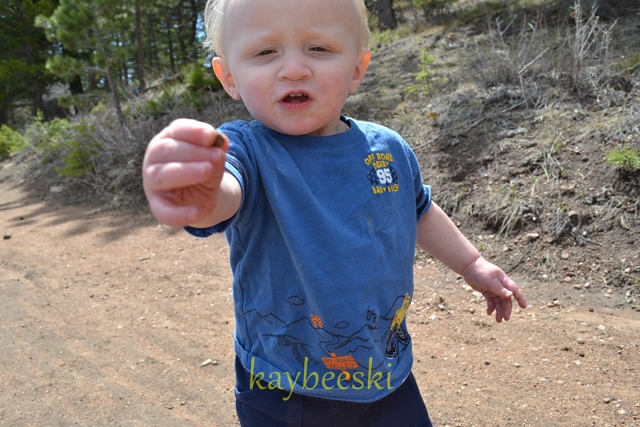
And these two little boys were certainly the cutest ones on the trail.

Happy Mother's Day to me! They've definitely made me earn the title, but I sure do love these little guys. They make me oh so very happy!

Saturday, May 11, 2013
The Gratitude Grows - Part 2
I mentioned that there were a lot of presentations at the NBSGTS meeting and I would be remiss to not mention at least some of them here because one of the most touching things about the entire conference was the passion of the presenters. It was evident that babies and families are at the very heart of everything that they are doing - the research, the quality indicators, the treatment trials, everything! There is an army of people out there who are working day-in and day-out to find these conditions before children become symptomatic so that they are never in harm's way. These same people are also working tirelessly to track these children to ensure that they are getting appropriate follow-up care throughout their lives so that they can stay healthy and asymptomatic and therefore, safe. It was such an incredible comfort to me to know that so many people care so deeply about this topic and about the babies and families that are affected. We, as families of those impacted by newborn screening, are certainly not alone.
Since I went to about a gazillion presentations, I won't mention all of them here (at least not right away!), but here are some of the highlights of a few presentations that made a big impact on me. I'll post more in the weeks to come and I'll hopefully also be hunting down some of the journal articles that go into greater detail than the presentations did.
Quality Indicators for Newborn Screening Programs - How do states know how well their newborn screening program is doing and how they stack up against other newborn screening programs across the country and around the world? They have quality indicators! There are 8 main indicators that describe a quality newborn screening program including things like the percentage of newborn screening cards that arrive at the lab and are deemed invalid (due to issues with collection/saturation and/or transport), the number of cards that arrive which are missing essential information, the time it takes cards to get from the hospital to the lab, the time it takes for the lab to process screening cards and the time it takes for labs to initiate follow-up with individuals who screen positive, etc.
This presentation was particularly poignant for me because it just so happens that the state where we used to live (we moved when we were pregnant) had one of the highest rates of invalid specimens. It was glaringly high (17%) compared to practically all other states (1-4%) in the study. When specimens are invalid, it means that the newborn screening cannot take place until a new card is properly collected from that infant. This can slow down the process by several days and could mean the difference between life and death for kids with metabolic disorders. I'm thankful that LB's screening was done right the first time and that we had information about how to keep him safe when he was three days old, never allowing him to be in danger from fasting.
MCADD and Newborn Screening in Japan - MCADD is the most common fatty acid oxidation disorder in Japan and is detected at a rate of 1:110,000 individuals. They did a study on infants born between 1997 and 2012 and found 18 cases of MCADD. Of those 18 cases, 8 of the children were discovered through newborn screening programs before they became symptomatic and the other 10 were discovered clinically once they became symptomatic (i.e. they were not discovered through the screening program). The age at onset for the symptomatic group was under 2 years old and hypoglycemia (low blood sugar) was observed in all 10 cases while hyperammonemia (metabolic crisis) was observed in half of those cases. For this symptomatic group, 8 out of 10 children exhibited some form of developmental delay, 1 child was deceased and 1 child displayed normal development. For the asymptomatic group discovered through newborn screening 100% of children were exhibiting normal development.
This presentation underscored the importance of finding children with metabolic disorders like MCADD early so that they can avoid episodes of metabolic crisis and live healthy, normal lives. I'm thankful again that we know about LB's condition and that we found out about it early, before he had any symptoms that could have had a detrimental affect on his development. He is perfectly healthy thanks to early intervention through newborn screening.
New Cystic Fibrosis Therapies - I know Cystic Fibrosis (CF) isn't a metabolic disorder, but it IS a disorder detected by newborn screening and this presentation made me jump for joy. CF has an incidence rate of 1:3500 births (much more prevalent than MCADD) and there are currently about 35,000 people living with CF in the United States. CF is a progressive lung disease and currently has a median predicted survival age of 37 years, while the median age at death is 26 years. These statistics may seem grim, but only a decade ago, you could probably shave a decade off each of these numbers. They are definitely going in the right direction. One of the reasons for this is all of the new therapies that are being developed. For example, there is currently a drug that is hitting a home run for CF patients with a particular gene mutation. In four years on the drug, all of the patients saw a sustained and remarkable increase in lung function. A similar drug is currently undergoing trials and is VERY exciting because this drug would target the gene mutation that causes 80-90% of CF cases. So far, it looks like this drug will also be a home run.
Wouldn't it be awesome if drug therapies like this could improve the lives of 95% of people with CF? Maybe even 100% if they can figure out how to treat the remaining genetic cause of CF that impacts that final 5% of CF cases? It is exciting to think about what those median survival ages might be only a decade from now! These kids could be living well into adulthood, maybe even into retirement! I'm amazed and grateful at what the scientific community has come up with here. What a blessing for all of the CF families out there!
Since I went to about a gazillion presentations, I won't mention all of them here (at least not right away!), but here are some of the highlights of a few presentations that made a big impact on me. I'll post more in the weeks to come and I'll hopefully also be hunting down some of the journal articles that go into greater detail than the presentations did.
Quality Indicators for Newborn Screening Programs - How do states know how well their newborn screening program is doing and how they stack up against other newborn screening programs across the country and around the world? They have quality indicators! There are 8 main indicators that describe a quality newborn screening program including things like the percentage of newborn screening cards that arrive at the lab and are deemed invalid (due to issues with collection/saturation and/or transport), the number of cards that arrive which are missing essential information, the time it takes cards to get from the hospital to the lab, the time it takes for the lab to process screening cards and the time it takes for labs to initiate follow-up with individuals who screen positive, etc.
This presentation was particularly poignant for me because it just so happens that the state where we used to live (we moved when we were pregnant) had one of the highest rates of invalid specimens. It was glaringly high (17%) compared to practically all other states (1-4%) in the study. When specimens are invalid, it means that the newborn screening cannot take place until a new card is properly collected from that infant. This can slow down the process by several days and could mean the difference between life and death for kids with metabolic disorders. I'm thankful that LB's screening was done right the first time and that we had information about how to keep him safe when he was three days old, never allowing him to be in danger from fasting.
MCADD and Newborn Screening in Japan - MCADD is the most common fatty acid oxidation disorder in Japan and is detected at a rate of 1:110,000 individuals. They did a study on infants born between 1997 and 2012 and found 18 cases of MCADD. Of those 18 cases, 8 of the children were discovered through newborn screening programs before they became symptomatic and the other 10 were discovered clinically once they became symptomatic (i.e. they were not discovered through the screening program). The age at onset for the symptomatic group was under 2 years old and hypoglycemia (low blood sugar) was observed in all 10 cases while hyperammonemia (metabolic crisis) was observed in half of those cases. For this symptomatic group, 8 out of 10 children exhibited some form of developmental delay, 1 child was deceased and 1 child displayed normal development. For the asymptomatic group discovered through newborn screening 100% of children were exhibiting normal development.
This presentation underscored the importance of finding children with metabolic disorders like MCADD early so that they can avoid episodes of metabolic crisis and live healthy, normal lives. I'm thankful again that we know about LB's condition and that we found out about it early, before he had any symptoms that could have had a detrimental affect on his development. He is perfectly healthy thanks to early intervention through newborn screening.
New Cystic Fibrosis Therapies - I know Cystic Fibrosis (CF) isn't a metabolic disorder, but it IS a disorder detected by newborn screening and this presentation made me jump for joy. CF has an incidence rate of 1:3500 births (much more prevalent than MCADD) and there are currently about 35,000 people living with CF in the United States. CF is a progressive lung disease and currently has a median predicted survival age of 37 years, while the median age at death is 26 years. These statistics may seem grim, but only a decade ago, you could probably shave a decade off each of these numbers. They are definitely going in the right direction. One of the reasons for this is all of the new therapies that are being developed. For example, there is currently a drug that is hitting a home run for CF patients with a particular gene mutation. In four years on the drug, all of the patients saw a sustained and remarkable increase in lung function. A similar drug is currently undergoing trials and is VERY exciting because this drug would target the gene mutation that causes 80-90% of CF cases. So far, it looks like this drug will also be a home run.
Wouldn't it be awesome if drug therapies like this could improve the lives of 95% of people with CF? Maybe even 100% if they can figure out how to treat the remaining genetic cause of CF that impacts that final 5% of CF cases? It is exciting to think about what those median survival ages might be only a decade from now! These kids could be living well into adulthood, maybe even into retirement! I'm amazed and grateful at what the scientific community has come up with here. What a blessing for all of the CF families out there!
The Gratitude Grows - Part 1
This week, I had the awesome opportunity to attend the 2013 Joint meeting of the Newborn Screening and Genetic Testing Symposium (NBSGTS) and the International Society for Neonatal Screening in Atlanta, GA with my fellow Consumer Task Force Moms (and Dads!). I am excited to report that it was one of the most powerful experiences of my life. I learned so much about newborn screening and met countless people who have such an incredible passion for saving babies lives along with improving the lives of individuals who are living with the conditions detected by screening. It was nothing short of phenomenal. It was also very emotional, but I swear that I only cried a little.
Probably the coolest thing about this conference was meeting the other members of the Task Force and sharing our stories with one another face-to-face. I was lucky enough to be paired up with the mother of a child with Very Long Chain Acyl CoA Dehydrogenase Deficiency (VLCADD) as my roommate and the two of us had so much in common - we both have two boys who are very similar in age with our youngest boys both being the ones who are affected by a metabolic disorder. Although all of our family and friends have been nothing but supportive, there really is nothing that can match the power of being with someone else who has actually been through the things that you have with your child, with the hospital stays, with the sleep deprivation, with the worry and with all those crazy thoughts that pass through your head that you are oftentimes too scared/embarrassed to talk about with anyone else. The two of us talked through it all and it was hugely comforting to know that we are not alone.
Not only was my roommate amazing, all of the other task force members were amazing, too. Several of them spoke on a parent/patient panel on Wednesday and those of us in the audience were holding back tears at several points during their presentations. Everyone was sharing their gratitude for what the newborn screening system accomplished in their lives. A man with phenylketonuria (PKU) talked about how although he received early intervention and is completely healthy, he once met a girl who didn't get early intervention like he did and she was profoundly disabled. He contemplated what his life would have been like if his story was her story and he was similarly disabled. He also thought long and hard about what her life could have been like if her story was more like his story and she was also identified early and prevented from becoming symptomatic.
Another woman on the panel was the mother of a child with LCHADD (Long Chain Acyl CoA Dehydrogenase Deficiency) and not only was she grateful that newborn screening saved her child's life, she was also grateful that it saved hers. Apparently in the LCHADD and VLCADD metabolic disorders, the unborn child's metabolic disorder can impact the mother's health during pregnancy. This mother was in a coma, in renal failure at the end of her pregnancy and the doctor's didn't know how to help her until they realized that her baby had LCHADD. The diagnosis saved both of them.
Other moms talked about their experiences parenting children with Cystic Fibrosis (CF), Sickle Cell Disease and Critical Congenital Heart Disease (CCHD) - disorders that require huge amounts of intervention and frequent hospital stays. One mom's child had been through 6 open heart surgeries and he was only 10 years old. I say "only 10 years old," but the reality is that 10 is an incredible age for a child with CCHD. They told his mom that he would be quite lucky to make it to his fifth birthday, but he is beating the odds! They are absolutely kicking CCHD's butt (and helping lots of other families along the way).
Although we were attending presentations on our own during the day, we got together as a group during the lunches and breaks to touch base with one another. It was cool to see us putting our heads together and decoding some of the technical/medical jargon with each other. The metabolic moms had experience and vocabulary for the metabolic presentations, while the CF mom had all the lung lingo down and the CCHD moms had the heart lingo down. We all helped each other understand different parts of the meeting and I know that my knowledge in certain areas was solidified by hearing the more technical information from the presentations and then helping to translate it to those around me who had questions.
While we were there, they filmed some interviews with all of us that they are going to weave into a video about newborn screening. They asked us about how newborn screening has impacted our families, how important it is, what we tell or want to tell other families about it, etc. My interview only took about 15 minutes, but it was definitely emotional. I don't know if I'll ever be able to talk about newborn screening without getting emotional. It saved my son's life. I don't know if there's every anything that I'll be more grateful for!
We also had a few get-togethers during the meeting where we were discussing our up-coming projects. Everyone had incredible ideas for things they wanted to do -- outreach to hospitals, doctors, pediatricians, expectant parents, plus ideas for books for children, webinars that would give CEUs to individuals in the medical community and much much more! I had about 3 ideas for what I wanted to do for my project going into the meeting and I left with double that amount. I'm going to need to spend the next couple months narrowing things down so that I can get something accomplished before the end of the year. I do know that I left this meeting with a huge sense of motivation. Everyone there was doing their part to keep babies like mine safe. Now, I just need figure out how I can also help make a difference.
Probably the coolest thing about this conference was meeting the other members of the Task Force and sharing our stories with one another face-to-face. I was lucky enough to be paired up with the mother of a child with Very Long Chain Acyl CoA Dehydrogenase Deficiency (VLCADD) as my roommate and the two of us had so much in common - we both have two boys who are very similar in age with our youngest boys both being the ones who are affected by a metabolic disorder. Although all of our family and friends have been nothing but supportive, there really is nothing that can match the power of being with someone else who has actually been through the things that you have with your child, with the hospital stays, with the sleep deprivation, with the worry and with all those crazy thoughts that pass through your head that you are oftentimes too scared/embarrassed to talk about with anyone else. The two of us talked through it all and it was hugely comforting to know that we are not alone.
Not only was my roommate amazing, all of the other task force members were amazing, too. Several of them spoke on a parent/patient panel on Wednesday and those of us in the audience were holding back tears at several points during their presentations. Everyone was sharing their gratitude for what the newborn screening system accomplished in their lives. A man with phenylketonuria (PKU) talked about how although he received early intervention and is completely healthy, he once met a girl who didn't get early intervention like he did and she was profoundly disabled. He contemplated what his life would have been like if his story was her story and he was similarly disabled. He also thought long and hard about what her life could have been like if her story was more like his story and she was also identified early and prevented from becoming symptomatic.
Another woman on the panel was the mother of a child with LCHADD (Long Chain Acyl CoA Dehydrogenase Deficiency) and not only was she grateful that newborn screening saved her child's life, she was also grateful that it saved hers. Apparently in the LCHADD and VLCADD metabolic disorders, the unborn child's metabolic disorder can impact the mother's health during pregnancy. This mother was in a coma, in renal failure at the end of her pregnancy and the doctor's didn't know how to help her until they realized that her baby had LCHADD. The diagnosis saved both of them.
Other moms talked about their experiences parenting children with Cystic Fibrosis (CF), Sickle Cell Disease and Critical Congenital Heart Disease (CCHD) - disorders that require huge amounts of intervention and frequent hospital stays. One mom's child had been through 6 open heart surgeries and he was only 10 years old. I say "only 10 years old," but the reality is that 10 is an incredible age for a child with CCHD. They told his mom that he would be quite lucky to make it to his fifth birthday, but he is beating the odds! They are absolutely kicking CCHD's butt (and helping lots of other families along the way).
Although we were attending presentations on our own during the day, we got together as a group during the lunches and breaks to touch base with one another. It was cool to see us putting our heads together and decoding some of the technical/medical jargon with each other. The metabolic moms had experience and vocabulary for the metabolic presentations, while the CF mom had all the lung lingo down and the CCHD moms had the heart lingo down. We all helped each other understand different parts of the meeting and I know that my knowledge in certain areas was solidified by hearing the more technical information from the presentations and then helping to translate it to those around me who had questions.
While we were there, they filmed some interviews with all of us that they are going to weave into a video about newborn screening. They asked us about how newborn screening has impacted our families, how important it is, what we tell or want to tell other families about it, etc. My interview only took about 15 minutes, but it was definitely emotional. I don't know if I'll ever be able to talk about newborn screening without getting emotional. It saved my son's life. I don't know if there's every anything that I'll be more grateful for!
We also had a few get-togethers during the meeting where we were discussing our up-coming projects. Everyone had incredible ideas for things they wanted to do -- outreach to hospitals, doctors, pediatricians, expectant parents, plus ideas for books for children, webinars that would give CEUs to individuals in the medical community and much much more! I had about 3 ideas for what I wanted to do for my project going into the meeting and I left with double that amount. I'm going to need to spend the next couple months narrowing things down so that I can get something accomplished before the end of the year. I do know that I left this meeting with a huge sense of motivation. Everyone there was doing their part to keep babies like mine safe. Now, I just need figure out how I can also help make a difference.
Subscribe to:
Posts (Atom)